
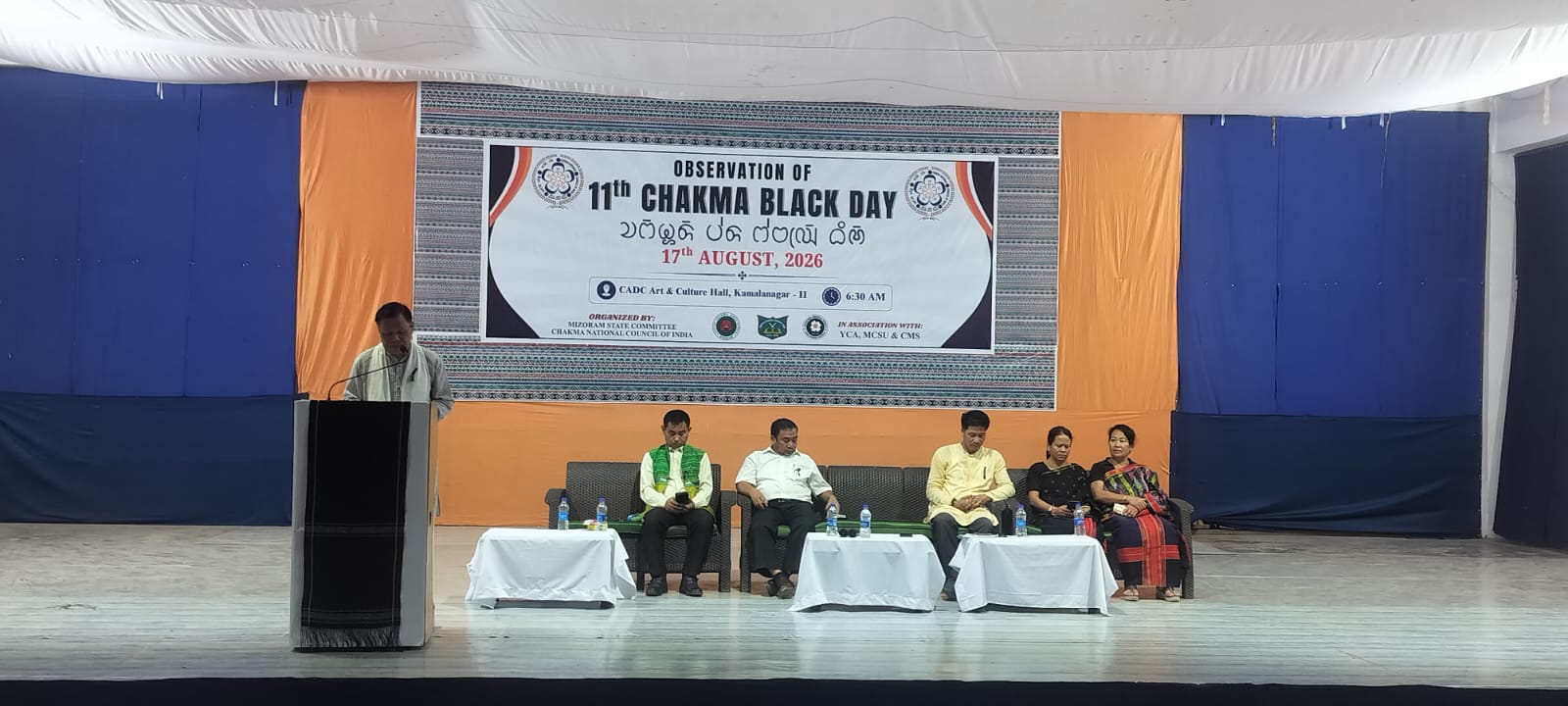
Kamalanagar, 17 August 2026: The Chakma National Council of India (CNCI), Mizoram State Committee, in association with Central Young Chakma Association, Central Mizoram Chakma Students’ Union and Chakma Mahila Samiti, observed the 11th Chakma Black Day today at the CADC Art & Culture Hall, Kamalanagar, the headquarters of Chakma Autonomous District Council (CADC) in Mizoram to commemorate the inclusion of the Chittagong Hill Tracts (CHT) in East Pakistan following the Partition of India in 1947.
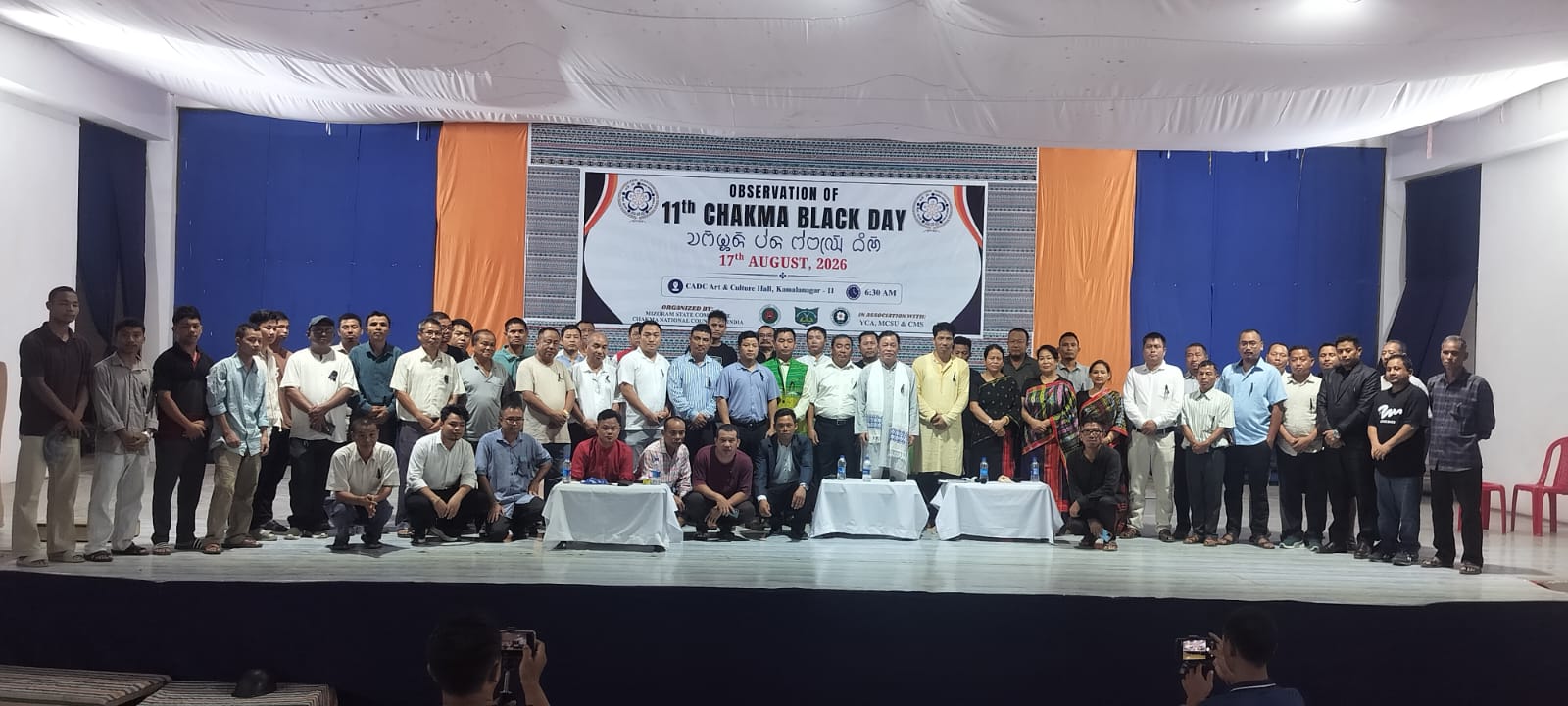
The observance marked 17 August 1947, when the Radcliffe Boundary Commission Award was publicly announced and the CHT was placed in East Pakistan. The speakers described the decision as a historical injustice, noting that the CHT was overwhelmingly inhabited by non-Muslim indigenous communities, including the Chakmas and other Jumma peoples.
Addressing the gathering, Dg. Nirupam Chakma, Chief Executive Member (CEM), CADC and National President, CNCI, said that the historical circumstances surrounding the inclusion of the CHT in Pakistan were recorded in contemporary documents and should not be treated merely as an oral tradition or community sentiment. Referring to the minutes of a meeting held in New Delhi on 16 August 1947, he said that Pandit Jawaharlal Nehru had objected to the possibility of the CHT being allocated to East Bengal. He referred to Nehru’s observation that the CHT was an excluded area, had no representation in the Bengal Council and had a population that was approximately 97 per cent Buddhist and Hindu. Nehru had also stated that there was no doubt that the people of the CHT preferred to form part of India and that, on religious and cultural grounds, the CHT should form part of India.
Recalling the events surrounding Independence, the speakers said that the indigenous people of the CHT had expected their homeland to remain in India. They recalled that the Indian National Flag was hoisted at Rangamati on 15 August 1947 and that the subsequent announcement of the Radcliffe Award on 17 August revealed that the CHT had been included in Pakistan.
Dg. Nirupam Chakma said that the allocation of the CHT was particularly significant because the area had an overwhelmingly non-Muslim population. He referred to the historical record as evidence of the objections raised at the time and described the decision as a rupture in the historical, cultural and political life of the Chakma people and other indigenous peoples of the CHT. The contemporary record also shows that the allocation was disputed during the 16 August meeting, where Nehru questioned whether it was within the terms of reference of the Boundary Commission and argued that the CHT should form part of India on religious and cultural grounds.
The speakers further recalled the long-term consequences following the Partition, including displacement, loss of ancestral land, insecurity and other hardships suffered by the indigenous peoples of the CHT. Dg. Nirupam Chakma referred in particular to the subsequent displacement caused by the Kaptai Dam, which submerged large areas of cultivable land and displaced large numbers of people from the CHT.
Dg. Nirupam Chakma said that 17 August is a day of remembrance and not celebration. He made it clear that Chakma Black Day is not directed against any community, religion or country, and that the observance is not against the people of Bangladesh or ordinary citizens. He said the purpose is to remember historical events, preserve Chakma identity and peacefully express the community’s aspirations. He also said that remembering history and maintaining friendship among peoples are not contradictory and that historical issues should be discussed honestly and respectfully.
Calling upon the younger generation, Dg. Nirupam Chakma urged Chakmas to study their history and original documents, preserve their language, literature, music, dance and traditional knowledge, strengthen education, create opportunities for youth, improve their economic position and protect their constitutional rights. He called upon the community to remain united and pursue its aspirations through peaceful, democratic and constitutional means.
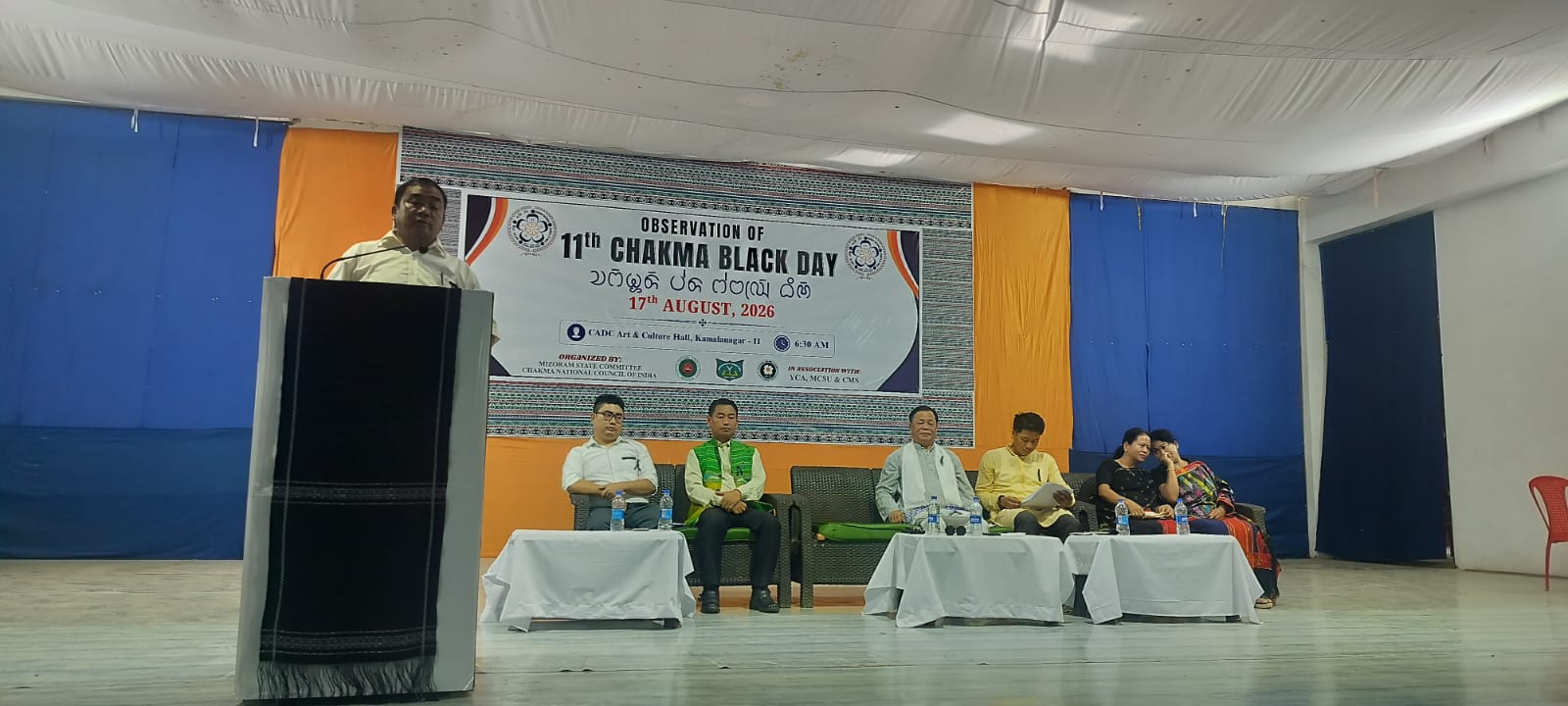
The significance of the day was also addressed by Dg. Kali Kumar Tongchangya, Chairman, CADC; Dg. Amarsmriti Chakma, Vice-President, CNCI Mizoram State Committee; Dg. Santosh Chakma, Religious Secretary, CYCA; Dangubi Indu Moti Dewan, Senior Vice-President, CMS; and Dg. Parbesh Chakma, President, CMCSU.
The speakers emphasised the importance of preserving Chakma history, identity, language, culture and heritage while strengthening unity among the community and ensuring that the younger generation remains conscious of its historical roots.
They also recalled that the CNCI adopted the decision to observe 17 August as Chakma Black Day at its National Convention in Guwahati in 2016. Since then, the day has been observed annually in different parts of India to remember the historical events surrounding the CHT’s inclusion in Pakistan and to create greater awareness among the Chakma community and the wider public.
The programme was attended by CADC MDCs, Village Council Presidents (VCPs), representatives of Br. YCA, Kamalanagar area, CDCTA, CDCEA, CDCOA, CDPA and representatives of political parties of the CADC.
The observance concluded with a call to preserve Chakma history and identity, maintain unity and work for the welfare and progress of the community through peaceful, democratic and constitutional means.
No. 30/2026-27


